Power Supply for 4 Post Car Lifts: How to Choose Yours
Used New Car is reader-supported: some links on this page are affiliate links, and as an Amazon Associate Used New Car earns from qualifying purchases at no extra cost to you. Learn more.
Power Supply for 4 post car lifts is the electrical pressure, measured in V, that provides the necessary energy to operate the lifting motor. The correct value is determined by whether your workshop uses standard household outlets or industrial power infrastructure.
Which Power Supply Suits Your Workshop?
| If this is you | The Power Supply that suits you | Why |
|---|---|---|
| You are setting up a home garage with standard wall outlets. | 110V | This matches the standard residential voltage in most North American households. |
| You have access to a dedicated industrial power drop. | 220V | This higher voltage is standard for heavy-duty machinery in commercial workshops. |
| You are installing a lift in a commercial automotive bay. | 220V | Commercial environments often utilize 220V to support high-torque motors efficiently. |
| You are retrofitting a lift in a region with non-standard voltage. | Check local utility specs | The lift must match the specific voltage provided by your local power grid. |
4 Post Car Lifts we have reviewed in detail
Prices across these 3 run from $3359 to $3899; each one has a full review here.
If you are looking for a home garage setup, see our top-rated 4 post car lift for home garage options.


How do I measure my workshop’s Power Supply?
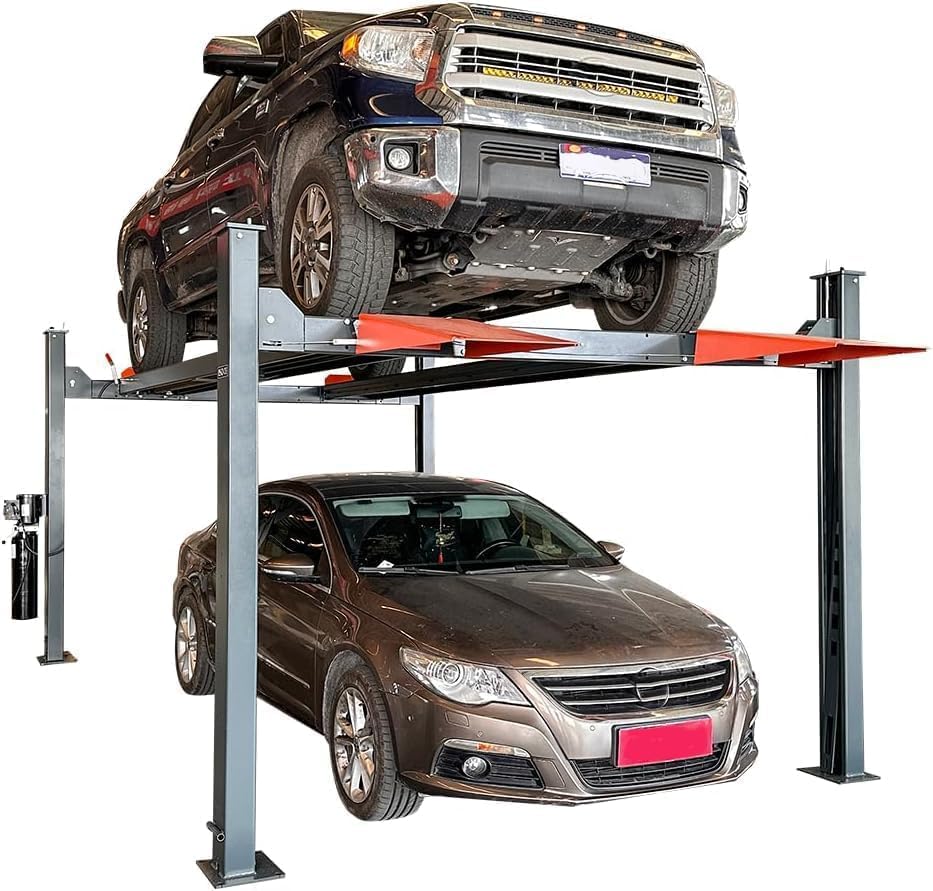
To determine the correct Power Supply for your 4 post car lift, you must identify the voltage of the outlets where the lift will be plugged in. Most workshop locations provide either 110V or 220V, and the lift’s motor must match this input exactly to function.
Ensure your vehicle fits by browsing the best 4 post car lift for wide vehicles in our guide.
Locating the voltage on your electrical outlets
Look for the voltage rating printed directly on the face of the wall outlet or the circuit breaker panel. In many regions, standard residential outlets are 110V, while large, heavy-duty outlets—often used for ovens or industrial tools—are 220V. If the markings are missing, you can use a multimeter to measure the voltage of the specific circuit where the lift will reside.
Residential owners should explore the best 4 post car lift for residential parking for their driveway.
Confirming your workshop’s power infrastructure
Verify the total capacity of the circuit to ensure it can handle the 4 post car lift’s power draw once the motor is engaged. A 110V circuit may require a dedicated line to prevent tripping breakers during heavy lifting cycles. If you are unsure of the capacity, a qualified electrician can verify the amperage and voltage of your workshop’s specific power drop.
You can find the best 4 post car lift for heavy duty trucks under 4000 dollars in our comparison.
What happens if the Power Supply is incorrect?
Selecting the wrong Power Supply for a 4 post car lift leads to immediate mechanical or electrical failure. If a lift designed for 220V is connected to a 110V source, the motor will lack the necessary torque to move the vehicle, often resulting in the lift failing to engage or moving at a fraction of its intended speed. Conversely, connecting a 110V lift to a 220V source will likely burn out the motor windings instantly because the electrical pressure is too high for the internal components to handle.
Learn more about how to choose your max lifting height before finalizing your purchase.
Incorrect voltage requirements can cause total motor failure
Choosing an incorrect voltage often results in a total loss of the motor’s functionality, requiring a complete replacement of the internal electrical system. This mistake forces a workshop to either pay for a costly electrical upgrade or order a new lift, as the motor cannot be easily “swapped” to a different voltage. It is like trying to run a high-powered industrial heater on a small hair dryer’s circuit; the system simply lacks the capacity to perform the task.
Understanding how to choose your lifting speed will help you determine the right motor for your needs.
What to do if your workshop falls between voltage values?
When a buyer’s situation falls between two voltage values, the decision depends on whether the local utility provides a stable 110V or 220V line. If your workshop has a “split-phase” system where both voltages are available, you must choose the one that matches the specific requirements of the 4 post car lift you intend to use.
For a deeper dive, see our full HPDMC-H150 Car Lift spec breakdown for more details.
Selecting between 110V and 220V options
If you have the choice between 110V and 220V, consider the current infrastructure of your building. If your workshop is already wired for 220V for other heavy machinery, selecting a 220V lift avoids the need for new wiring. However, if the building is strictly 110V, you must select a 110V lift or hire an electrician to install a 220V sub-panel.
You can find more technical details in our full MutsMover 4-Post Lift comparison online.
Consulting a qualified installer for voltage requirements
Because electrical requirements for 4 post car lifts involve high-torque motors, a qualified installer should verify your power supply before you finalize a purchase. They can confirm if your current breaker panel can support the specific amperage required by the lift’s motor. This ensures that the lift operates safely and does not cause a localized power failure or trip the breakers during use.
See how the unit performs in our full KT-4H950 4 Post Lift data analysis.
Steps to verify workspace power capacity for a 4 post car lift
A buyer first identifies the available outlets in their workspace and notes the voltage markings. They then compare that figure against the requirements of the 4 post car lift they are considering. Finally, they confirm with a professional that the specific circuit can handle the sustained power draw of the lifting motor.
Check out our full BendPak HD-7W spec analysis to see how it compares to others.
The other 4 post car lift guides we have published
- Choosing the Best Heavy Duty 4 Post Car Lift for Storage
- The 4 Post Car Lifts That Work Best for Tall Vehicles Under $4000
- Which 4 Post Car Lift Is Best for Wide Vehicles?
- Best 4 Post Car Lifts for Residential Parking
- Heavy Duty 4 Post Car Lifts for Trucks Under $4000 Compared
- Choosing the Best 4 Post Car Lift for Limited Space