Electric Golf Cart Terms and Specs, Explained in Plain English
Used New Car is reader-supported: some links on this page are affiliate links, and as an Amazon Associate Used New Car earns from qualifying purchases at no extra cost to you. Learn more.
Electric golf carts are battery-powered vehicles designed for low-speed transport on turf and paved surfaces. You need a system voltage of at least 48V for reliable speeds and hauling, which is the baseline for most capable models. Before choosing, you should measure the total weight of your passengers and cargo to determine if the motor power and battery capacity meet your specific needs.
Power and Performance Specifications
Motor power measures the rate of energy conversion into motion, which determines how quickly a cart can move and how much weight it can push. While many listings do not state a specific wattage, the models we screened range from 230W to 5,000W.
- Motor Power – This is the wattage rating of the motor; a higher number allows for better hill climbing and faster acceleration under load.
- System Voltage – This measures the electrical pressure of the power source, with 4 of the 10 listings we screened stating a value between 48V and 60V.
- Top Speed – This is the maximum velocity of the vehicle, with 3 of the 10 listings we screened stating a range from 9 to 25 MPH.
- Torque Converter – This component provides variable gear ratios for smooth acceleration and hill climbing; a high-quality converter prevents the motor from stalling when starting from a dead stop on an incline.
- Differential – This enables power distribution to both rear wheels for traction and turning; without a differential, the wheels would fight each other, causing tires to spin or the cart to struggle to turn.
- Controller – This regulates power flow from the battery to the motor based on throttle input; the controller acts as the brain of the drive system, determining how smoothly the cart responds to your foot.
Where these choices show up in our reviews
Each of the 3 shown here has its own full review on this site; they run from $1679.95 to $7999.
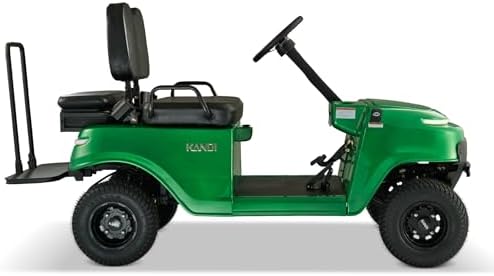
For a more compact option, see our full Kandi Mini Golf Cart review.


Battery Capacity and Charging Standards
Battery capacity determines the distance of travel on a course, which is the most frequent point of failure for buyers who underestimate their daily needs. We found that 5 of the 10 listings we screened state a capacity of 36 Holes.
- Battery Capacity – This measures the estimated distance of travel; a higher number of “holes” or a larger Amp-hour (Ah) rating allows for longer operation without a mid-day charge.
- Lead-Acid vs. Lithium-Ion – This is the choice between lower upfront cost with heavy weight versus high energy density and cycle life; Lithium-Ion generally offers more consistent power and a longer lifespan.
- AC vs. DC Charging – This determines if the vehicle requires a dedicated industrial charger or a standard wall outlet; AC charging is common for home use, while DC is often used for rapid charging in commercial settings.
- Replacement Battery – This extends the vehicle’s lifespan and range; ensure the replacement matches the voltage and physical mounting points of the original unit.
- Charging Cable – This allows for convenient power replenishment; the cable must match the connector type of the cart’s charging port to function.
How Physical Components Influence Golf Buggy Stability and Handling
Physical components dictate the handling and durability of the golf buggy, ensuring it remains stable on uneven terrain. These parts are the foundation of the cart’s safety and ride quality.
Detailed specifications are available in our full Zip X1 review.
- Steering Knuckle – This determines the geometry and stability of the front wheel assembly; the quality of the knuckle affects how much “play” you feel in the steering wheel.
- Roof Canopy – This provides shade and protection from precipitation; the canopy must be compatible with the frame’s mounting points to prevent rattling.
- Seat Cover – This protects upholstery from weather and wear; a high-quality cover prevents the seat from cracking under UV exposure or getting soaked in the rain.
Terms Often Confused by Buyers
Buyers often confuse motor power with system voltage, which can lead to incorrect expectations about how far or how fast a cart will travel. Motor power tells you the strength of the “muscle,” while system voltage tells you the “pressure” of the electricity provided.
Balancing battery capacity and motor power for range and climbing
Another common point of confusion is the difference between battery capacity and motor power. A large battery with a small motor will provide a long range but will struggle to climb hills; conversely, a powerful motor with a small battery will climb hills easily but will run out of power quickly. You must balance these two figures based on whether you prioritize distance or climbing ability.
See how the latest technology works in our full MGI Ai Navigator review.
Finally, some buyers mistake “top speed” for “acceleration.” A cart may have a high top speed but take a long time to reach it if the torque converter or motor power is insufficient. If you frequently start from a stop on a slope, prioritize the torque converter and motor power over the maximum velocity.
Browse our other electric golf cart pages
- Which 4 Seater Electric Golf Cart Is Best?
- Best Electric Golf Cart with Remote Control
- Long Range Electric Golf Carts Under $8500 Compared
- Choosing the Best Golf Shuttle for Transport
- The Electric Golf Carts That Work Best with Lithium Batteries
- Which Electric Golf Cart Is Best for Neighborhood Use?