A 4 Post Car Lift Terms and Specs, Explained in Plain English
Used New Car is reader-supported: some links on this page are affiliate links, and as an Amazon Associate Used New Car earns from qualifying purchases at no extra cost to you. Learn more.
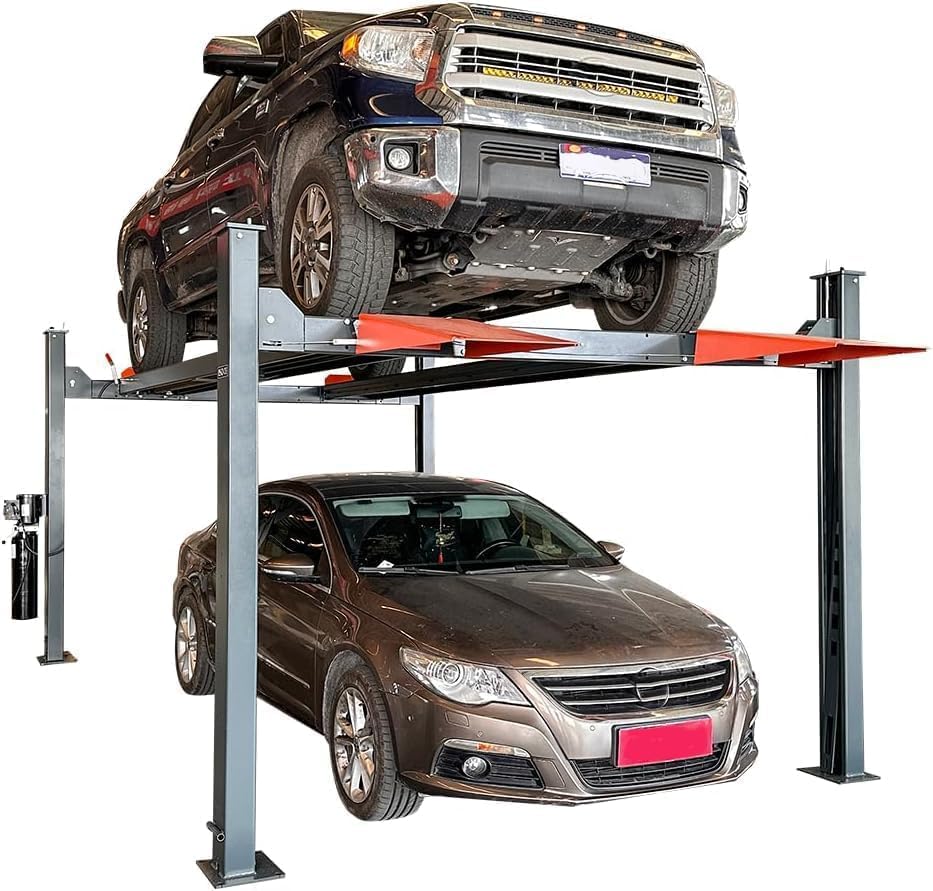
A 4 post car lift is a garage vehicle hoist that uses four vertical posts and two horizontal runways to elevate a vehicle for service. You need a lift with a weight capacity that exceeds your heaviest vehicle’s gross weight, which usually requires a capacity of at least 10,000 lbs for standard cars. You must measure your garage’s ceiling height and the length of your vehicle to ensure the lift provides enough clearance for the work you intend to perform.
4 Post Car Lift Capacity and Power Specs
- Weight Capacity – This is the maximum total mass the structure can safely support, and a higher number is better for accommodating heavier trucks or SUVs.
- Max Lifting Height – This measures the vertical distance from the ground to the highest point of the platform, where a higher value allows for more clearance under the vehicle.
- Power Supply – This specifies the electrical pressure of the input source, with 110V common for standard outlets and 220V often required for industrial power infrastructure.
- Motor Power – This is the mechanical work output rate of the engine, which determines how quickly the lift raises or lowers the vehicle.
- Hydraulic vs Electric – This dictates the lifting mechanism, where hydraulic systems use fluid pressure and electric systems use motor-driven gears to move the lift.
- Hydraulic Cylinder – This component determines the lifting force and fluid pressure capacity of the system.
Structural Integrity of 4 Post Car Lifts
Steel Gauge refers to the thickness of the metal used in the lift’s construction, where a “Heavy Duty Gauge” provides greater resistance to bending. Many listings state a specific steel gauge to indicate the structural integrity of the posts and runways. If the gauge is too thin, the lift may experience structural deflection, which is when the steel bows or warps under a maximum load.
If you are shopping for a personal garage, see our comparison of the best 4 post car lift for home garage use.
Runway Beam is the structural surface that supports the vehicle’s weight during lifting. The width of these beams determines if the lift is “Extra Wide,” a feature stated by some listings to accommodate wider trucks or specialty vehicles.
Owners of oversized vehicles should look at the best 4 post car lift for wide vehicles options.
Where these choices show up in our reviews
Each of the 3 shown here has its own full review on this site; they run from $3359 to $5799.
To understand the different configurations available, explore the different types of 4 post car lifts explained.


4 Post Car Lift Safety and Synchronization
- Rotary Drive System – This ensures synchronized lifting of all four posts to prevent vehicle tilting, which is the professional standard for smooth movement.
- Safety Locking Mechanism – This provides a mechanical fail-safe to hold the vehicle during storage or service.
- Manual Safety Lock – This is a specific type of safety lock where the user manually engages a physical block to secure the lift at a certain height.
- Locking Pin – This specific part secures the lift at specific height increments to ensure the vehicle does not move while it is being worked on.
Required 4 Post Car Lift Accessories
Replacement Hydraulic Fluid is a consumable that maintains system pressure and prevents seal degradation over time. You must ensure the fluid matches the specific viscosity requirements of the lift’s hydraulic cylinder to maintain consistent lifting performance.
For a deep dive into high-capacity options, see our full HPDMC-H150 Car Lift review for data.
A Jack Tray provides a designated area for tools and jacks to keep the workspace clear. While not required for the lift to function, it helps organize the floor space around the base of the posts.
You can view our full MutsMover 4-Post Lift review to see the detailed technical specifications.
Commonly Confused 4 Post Car Lift Terms
Weight Capacity and Max Lifting Height are often confused, but they measure different dimensions. Weight capacity refers only to the total mass the lift can hold, while lifting height is the vertical distance the lift can travel. A lift can have a high weight capacity but a low lifting height, meaning it can hold a heavy truck but not lift it high enough to clear a large engine.
For a breakdown of the 3.0 HP model, see our full KT-4H950 4 Post Lift review here.
Differences between hydraulic and electric 4 post car lift mechanisms
Hydraulic vs Electric refers to the power source and movement method, not the power supply voltage. A lift can be either hydraulic or electric, and it can run on either 110V or 220V power. You must check both the lifting mechanism and the voltage requirements to ensure your garage has the correct infrastructure.
Detailed performance data is available in our full BendPak HD-7W review for this 7,000 lb model.
How synchronization drift and structural deflection cause 4 post car lift failure
Synchronization Drift and Structural Deflection are both failure modes but occur differently. Synchronization drift happens when the posts move at different speeds, causing the vehicle to tilt. Structural deflection happens when the metal itself bends because the steel gauge is insufficient for the weight being lifted.
Browse our other 4 post car lift pages
- The 4 Post Car Lifts That Work Best for Tall Vehicles Under $4000
- Which 4 Post Car Lift Is Best for Wide Vehicles?
- Best 4 Post Car Lifts for Residential Parking
- Heavy Duty 4 Post Car Lifts for Trucks Under $4000 Compared
- Choosing the Best 4 Post Car Lift for Limited Space
- The 4 Post Car Lifts That Work Best for Beginners