The Types of 4 Post Car Lifts, Explained
Used New Car is reader-supported: some links on this page are affiliate links, and as an Amazon Associate Used New Car earns from qualifying purchases at no extra cost to you. Learn more.
4 post car lifts are categorized by their weight capacity, which dictates the maximum total mass the structure can safely support. You need a lift with a capacity that exceeds the gross weight of your heaviest vehicle to ensure structural integrity. Measure the total weight of your heaviest vehicle, including fluids and equipment, to determine the minimum required capacity.
A 4 Post Car Lift Types Among the Listings We Screened
| Type | What sets it apart | Listings we screened | Price range | Median weight capacity |
|---|---|---|---|---|
| Light Duty Lift | weight capacity up to 7,000 lbs | 1 | $5799 | – |
| Medium Duty Lift | weight capacity 7,000 to 11,000 lbs | 2 | $3359 to $3899 | 10,250 lbs |
| Heavy Duty Lift | weight capacity 11,000 lbs and up | 1 | $3359 | – |
Counted over the 4 listings this site screened; a listing that does not state the figure a type is defined by is not counted under any type.
Where these choices show up in our reviews
Prices across these 3 run from $3359 to $5799; each one has a full review here.
If a lift isn’t right for your project, explore the alternatives to a 4 post car lift for other results.


Light Duty 4 Post Car Lifts
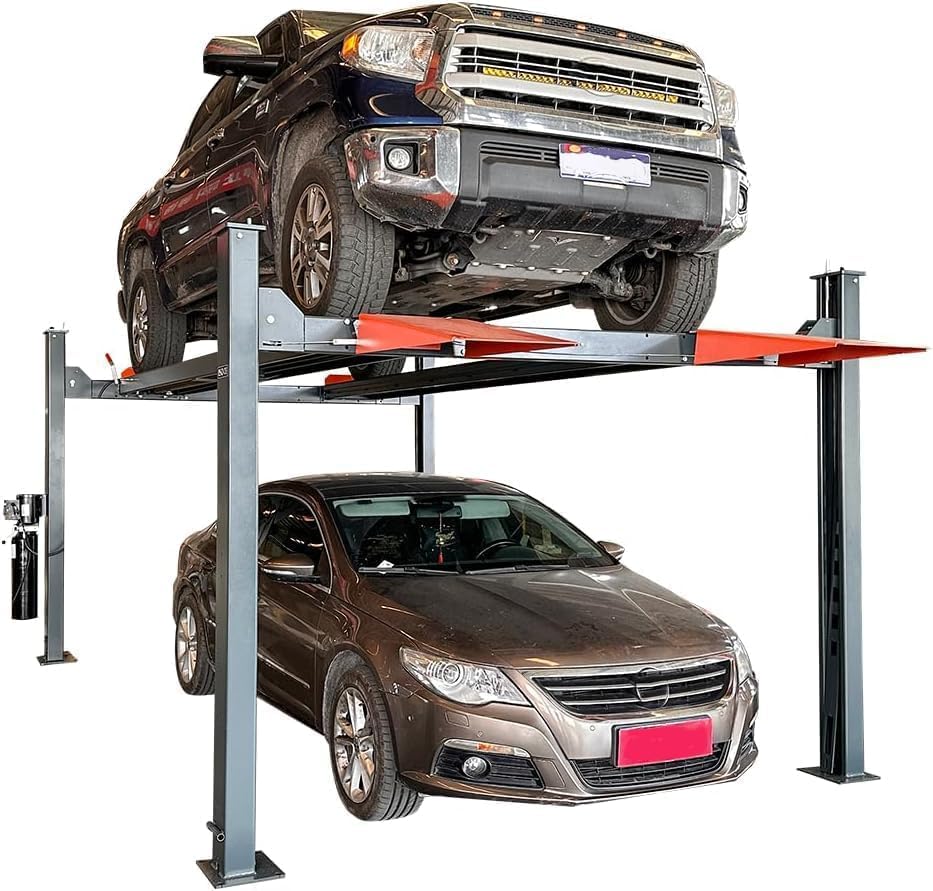
Light Duty 4 post car lifts are defined by a weight capacity of up to 7,000 lbs. These units are designed for personal use with smaller vehicles, such as compact cars, motorcycles, or small crossovers. Because they use lighter-gauge steel and smaller motors, they offer a lower entry price point but cannot support heavy-duty trucks or large SUVs.
How light duty 4 post car lifts risk structural deflection
Choosing a light duty option when you intend to lift a heavy vehicle can result in structural deflection, where the lift’s frame bows or warps under load. This deformation can lead to an unstable lift position or permanent damage to the frame. If your vehicle weighs near the 7,000 lbs limit, you risk exceeding the safe operating threshold of the lifting mechanism.
Safety is paramount, so review the required certifications and safety standards for these systems.
Medium Duty 4 Post Car Lifts
Medium Duty 4 post car lifts feature a weight capacity between 7,000 and 11,000 lbs. This category serves as the standard for most residential garage owners who need to lift a wide variety of passenger vehicles, including sedans, hatchbacks, and mid-sized SUVs. These lifts provide a balance between structural strength and cost, offering enough capacity for most consumer needs without the industrial pricing of heavy-duty models.
Why a 10,250 lb capacity provides a safety buffer
A median weight capacity of 10,250 lbs in this category allows for a significant safety margin when lifting standard trucks. If you are unsure of your vehicle’s exact weight, the 11,000 lb upper limit of medium duty provides a buffer that prevents the lift from operating at its absolute maximum capacity. This range is the most common choice for home workshops where the goal is versatility across different vehicle types.
Proper electrical setup is vital, so see how to choose the correct power supply for 4 post car lifts.
Heavy Duty 4 Post Car Lifts
Heavy Duty 4 post car lifts are defined by a weight capacity of 11,000 lbs and up. These units are engineered for high-capacity applications, such as lifting heavy-duty pickup trucks, large vans, or commercial vehicles. They utilize thicker gauge steel and more robust mechanical components to handle the extreme stress of high-mass loads without structural deflection.
Space and cost requirements for high capacity heavy duty lifts
While these lifts provide the highest capacity, they often require more floor space and may have a higher price point relative to medium duty options. If you need to lift a vehicle that exceeds the 11,000 lb threshold, a heavy duty lift is the only viable option. Using a lower-capacity lift for these vehicles can result in a catastrophic tip-over if the structure fails under the weight.
For a deep dive into the specs, see our full HPDMC-H150 Car Lift comparison.
4 Post Car Lift Type Comparison
| Type | Best-Fit Buyer | Main Advantage | Main Compromise |
|---|---|---|---|
| Light Duty | Owners of compact cars or motorcycles | Lowest entry price point | Limited to 7,000 lbs capacity |
| Medium Duty | Owners of sedans and mid-sized SUVs | Versatility for most passenger vehicles | Lower capacity than heavy-duty units |
| Heavy Duty | Owners of large trucks and vans | High-capacity structural strength | Higher cost and larger footprint |
How to Tell Which 4 Post Car Lift Type You Need?
To determine which 4 post car lift type you need, you must first identify the maximum weight of the vehicle you intend to lift. If your vehicle weighs less than 7,000 lbs, a light duty lift provides sufficient capacity for your needs. For vehicles weighing between 7,000 lbs and 11,000 lbs, a medium duty lift is the appropriate choice to ensure the structure does not warp under load.
Selecting heavy duty lifts for vehicles exceeding 11,000 lbs
If your vehicle exceeds 11,000 lbs, you must select a heavy duty lift to ensure the frame can support the mass. For example, a heavy-duty pickup truck often sits near the upper limits of consumer capacities. If you are unsure of the weight, choosing a model with a higher weight capacity than your vehicle provides a safety margin that prevents the lift from operating at its maximum limit.
Detailed performance data is available in our full MutsMover 4-Post Lift breakdown.
How Do These Lifts Compare to Professional Standards?
Professional standards in the lifting industry are defined by specialized systems like Rotary Drive Systems. These systems provide smooth, synchronized lifting that budget models lack, ensuring that the platform remains level during the entire lift cycle. While the 4 post car lifts on this page provide reliable lifting for personal use, they do not typically feature the synchronized rotation found in professional shop environments.
Differences between consumer 4 post car lifts and industrial units
The industry also recognizes 50,000 lb Industrial Lifts as the benchmark for structural engineering and safety factors in heavy-duty manufacturing. These industrial units are designed for extreme environments and massive loads that far exceed the requirements of a residential garage. The 4 post car lifts evaluated here are designed for consumer vehicle maintenance and do not reach the 50,000 lb capacity used in industrial manufacturing settings.
Research the technical capabilities in our full KT-4H950 4 Post Lift review.
What Happens if You Choose the Wrong Lift Capacity?
Choosing a lift with a weight capacity lower than your vehicle’s gross weight can result in a total loss of the lift and potential damage to your vehicle. If the structure is overloaded, the gauge steel can undergo structural deflection, where the frame bows or warps. This can cause the lift to become unstable, potentially leading to a tip-over or a permanent failure of the lifting arms.
Steps to identify the correct lift weight and footprint
A buyer first identifies the vehicle they need to lift and checks the manufacturer’s gross weight. They then look for a lift with a weight capacity that exceeds that number by a comfortable margin. Finally, they confirm the lift’s footprint fits their garage space before making the purchase. This sequence ensures the lift can safely handle the load while remaining stable during use.
High-capacity requirements are covered in our full BendPak HD-7W spec analysis.
How Much Clearance Do You Need for a 4 Post Car Lift?
How much clearance do you need for a 4 post car lift depends on the height of your vehicle and the desired clearance for work. A reference figure of 84 inches is the height required to clear most full-sized SUVs and trucks for overhead clearance. You should measure the distance from the ground to the highest point of your vehicle and add the amount of clearance you need to perform maintenance, such as changing tires or working on the undercarriage.
How to calculate required 4 post car lift height clearance
If you require a high amount of clearance, you must ensure the lift’s max lifting height exceeds your vehicle’s height plus your required workspace. For example, if a truck is 70 inches tall and you need 14 inches of clearance, you need a lift with a max lifting height of at least 84 inches. If the lift cannot reach this height, you will be unable to perform the necessary work on the vehicle.
Browse our other 4 post car lift pages
- Best 4 Post Car Lifts for Residential Parking
- Heavy Duty 4 Post Car Lifts for Trucks Under $4000 Compared
- Choosing the Best 4 Post Car Lift for Limited Space
- The 4 Post Car Lifts That Work Best for Beginners
- Which 4 Post Car Lift Handles a Heavy Truck for Undercarriage Repair?
- The 4 Post Car Lifts That Lift a Large Van for Maintenance