
Weight Capacity for 4 Post Car Lifts: How Much You Actually Need
Used New Car is reader-supported: some links on this page are affiliate links, and as an Amazon Associate Used New Car earns from qualifying purchases at no extra cost to you. Learn more.
Weight capacity for a 4 post car lift should generally range between 7,000 lbs and 15,000 lbs depending on the specific vehicles you intend to service. You need to select a lift where the rated capacity exceeds the gross vehicle weight of your heaviest planned use case by at least 10% to ensure structural longevity.
Recommended Weight Capacity for 4 Post Car Lifts
| Use Case | Recommended Weight Capacity | Why this number |
|---|---|---|
| Standard passenger cars and SUVs | 7,000 to 9,000 lbs | Covers the weight of most consumer vehicles while providing a buffer for heavy interior options. |
| Large cargo vans | 7,000 to 9,000 lbs | Calculated based on the 7,000 to 9,000 lb weight range of standard high-roof cargo vans. |
| Heavy-duty pickup trucks | 8,000 to 10,000 lbs | Required to safely support the gross weight of full-size pickups and heavy towing configurations. |
| Heavy trucks for undercarriage repair | 8,000 to 10,000 lbs | Ensures the lift can support the weight of a truck during active maintenance and lifting operations. |
| Heavy trucks for storage | 8,000 to 10,000 lbs | Provides the necessary structural support for long-term static weight of heavy commercial vehicles. |
| Heavy-duty commercial lifts | 15,000 lbs | The standard capacity for heavy-duty commercial and high-end residential lifts. |
4 Post Car Lifts we have reviewed in detail
Each of the 3 shown here has its own full review on this site; they run from $3359 to $5799.
Efficiency is key, so learn about optimal lifting speed for 4 post car lifts.
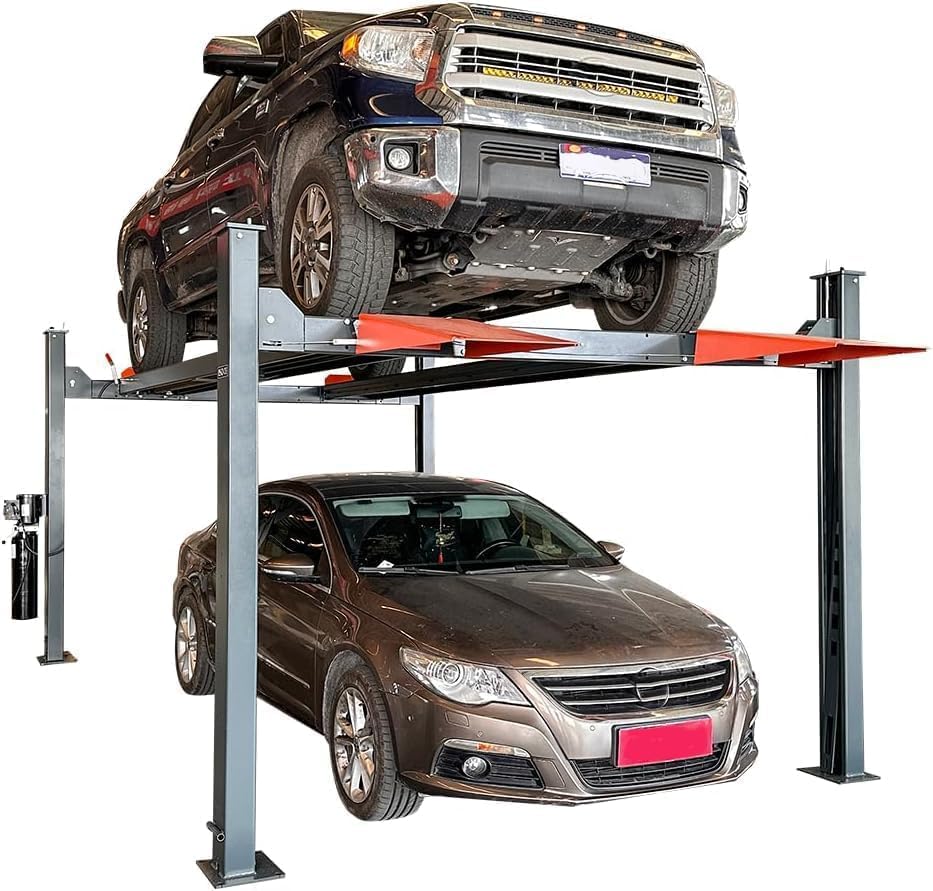


What happens if you go under or overbuy on 4 post car lift capacity?
If you select a 4 post car lift with a weight capacity below your vehicle’s requirements, the risk involves structural deflection. A lift with insufficient gauge steel will bow or warp under maximum load, which can lead to Synchronization Drift. This occurs when uneven lifting causes the vehicle to tilt, potentially causing a catastrophic tip-over. Choosing a lift that is under-specced for your needs can result in a total loss of the equipment and the vehicle it is holding.
Avoiding unnecessary costs by matching 4 post car lift capacity to vehicle weight
Overbuying on weight capacity involves paying for a higher structural rating than your specific use case requires. While a 15,000 lb lift provides a significant safety margin, it often requires thicker steel and larger components that increase the physical footprint and the cost of the unit. If you only ever plan to lift 3,000 lb sedans, a 15,000 lb capacity lift is an unnecessary expenditure of capital on structural overhead you will never utilize. It is like buying a freight elevator to move a suitcase; it functions, but the cost per use is inefficiently high.
For high-capacity heavy lifting, see our full HPDMC-H150 Car Lift review.
What is the most common mistake with 4 post car lift weight capacity?
Buyers often mistake the weight of the vehicle for the weight the lift must handle during specific operations. You should be optimising for the maximum gross weight of the vehicle including all fluids, fuel, and aftermarket modifications. A vehicle that weighs 6,000 lbs empty might reach 7,500 lbs when fully loaded with equipment or passengers. If you choose a lift based on the “curb weight” listed in a brochure rather than the “gross weight,” you may find the lift operating too close to its limit for comfortable use.
High-capacity lifting is covered in our full MutsMover 4-Post Lift review.
Accounting for total component mass when calculating 4 post car lift requirements
Another error involves failing to account for the weight of the components being worked on. If you are performing heavy undercarriage repairs that involve large components like engines or transmissions, the weight of the lift’s platform and the vehicle’s own weight must both be supported simultaneously. Always ensure the 4 post car lift rating accounts for the total mass of the vehicle in its heaviest possible configuration during the specific task you perform most often.
How does weight capacity interact with other 4 post car lift specs?
Weight capacity interacts with the motor power and the structural gauge of the lift’s posts. A high weight capacity is wasted if the motor power is insufficient to move that mass efficiently. While weight capacity measures the maximum total mass the structure can safely support, motor power measures the mechanical work output rate of the engine. If a lift is rated for 10,000 lbs but has a low-rated motor, the lifting speed may be significantly slower or the motor may overheat during repeated cycles.
Check the technical performance in our full KT-4H950 4 Post Lift review.
Matching facility electrical infrastructure to the 4 post car lift power needs
Weight capacity also dictates the requirements for the power supply. High-capacity lifts often require 220V power to provide the necessary electrical pressure of the input source to drive the heavy-duty motors. If you choose a high-capacity lift but only have access to standard 110V outlets, you will not be able to operate the lift at its intended capacity. Always verify that your facility’s electrical infrastructure matches the requirements of the weight capacity you select.
Detailed specifications are available in our full BendPak HD-7W review.
Ensuring heavy-gauge steel construction supports the 4 post car lift weight rating
Finally, weight capacity is tied to the material and construction of the lift’s base and columns. A lift with a high weight capacity rating must be built with heavy-gauge steel to prevent structural deflection. If the lift’s weight capacity is high but the base is not properly anchored or the columns are thin, the lift may lack the stability required for heavy trucks. Ensure that the weight capacity figure you choose is supported by the physical build quality of the 4 post car lift, as the capacity is only as reliable as the steel supporting it.
The rest of our 4 post car lift guides
- Which 4 Post Car Lift Handles a Heavy Truck for Undercarriage Repair?
- The 4 Post Car Lifts That Lift a Large Van for Maintenance
- Home Garage 4 Post Car Lifts Compared
- Choosing the Best Heavy Duty 4 Post Car Lift for Storage
- The 4 Post Car Lifts That Work Best for Tall Vehicles Under $4000
- Which 4 Post Car Lift Is Best for Wide Vehicles?