Motor Power for 4 Post Car Lifts: How Much You Actually Need
Used New Car is reader-supported: some links on this page are affiliate links, and as an Amazon Associate Used New Car earns from qualifying purchases at no extra cost to you. Learn more.
Motor power for a 4 post car lift typically ranges from 2 HP to 5 HP depending on the weight of the vehicles being moved. You should choose a motor that provides enough torque to lift your heaviest expected vehicle smoothly without straining the electrical system or the mechanical gears.
Recommended Motor Power by Use Case
| Use Case | Recommended Motor Power | Why this number |
|---|---|---|
| Passenger cars and small SUVs | 2 HP to 3 HP | Standard passenger vehicles weigh under 5,000 lbs, requiring a baseline motor for steady lifting. |
| Large SUVs and light trucks | 3 HP to 4 HP | Heavier vehicles require higher torque to overcome initial inertia and maintain a consistent lift speed. |
| Full-sized vans and heavy trucks | 5 HP | Lifting a large van for maintenance requires at least 2 to 5 HP to handle the higher mass and ensure safety. |
| High-frequency commercial use | 5 HP | Frequent lifting cycles require a motor with higher output to prevent overheating during continuous operation. |
4 Post Car Lifts covered by our own reviews
From $3359 to $5799: 3 of the 4 in this category we have reviewed in full.


What happens if you go under or overbuy motor power?
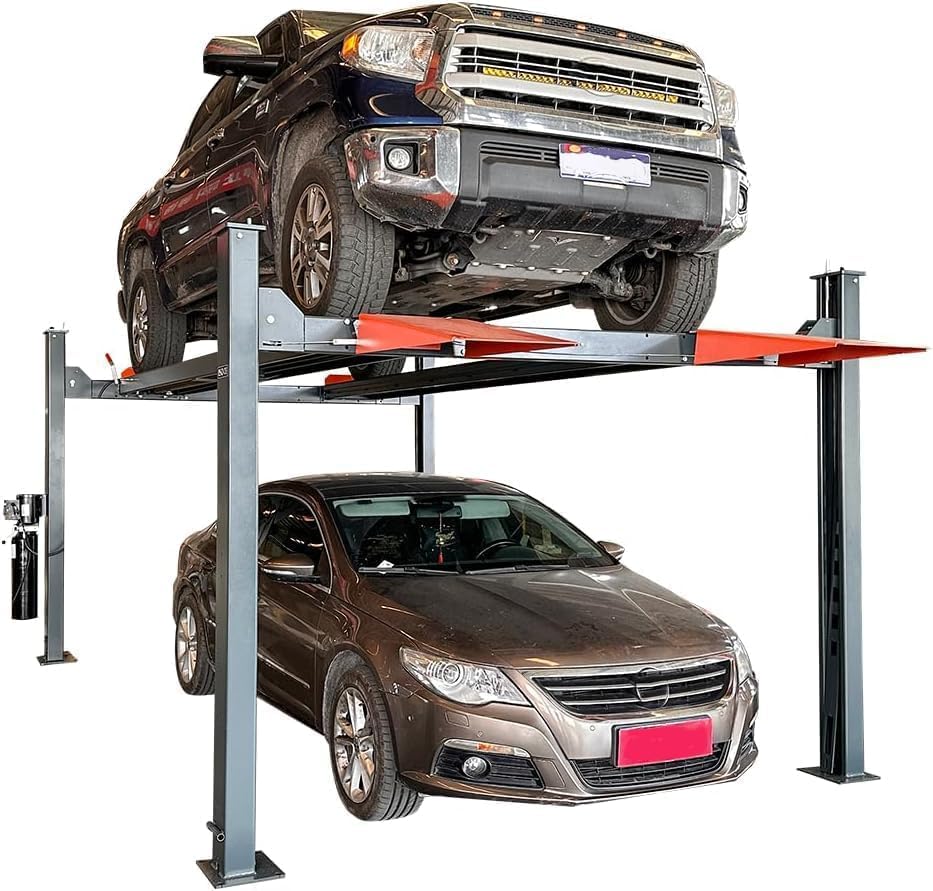
Under-powered motors for a 4 post car lift struggle to initiate movement when the lift is at its maximum weight capacity. If the motor lacks sufficient HP, the lift may move at a crawl or experience significant “stuttering” as the gears engage the load. This puts excessive stress on the motor’s internal windings and the lift’s transmission, which can lead to premature component failure or a complete stall during a lift cycle.
How overbuying 4 post car lift motor power affects costs and longevity
Overbuying motor power is a legitimate cost consideration for a budget-first shopper. While a 5 HP motor is capable of lifting a heavy truck, using it only for a 3,000 lb sedan does not make the lift faster or safer; it simply means the motor operates well below its capacity. While larger motors may have a higher initial cost, they often provide a longer service life because they do not work at their limit during every use. However, you should avoid excessively large industrial motors that require 3-phase power if your workshop only supports standard 110V or 220V outlets.
If a lift isn’t right for your space, explore the alternatives to a 4 post car lift.
What is the most common mistake with motor power?
The most common mistake is assuming that a higher HP rating automatically translates to a faster lifting speed. Motor power determines the torque and the ability to move weight, but the actual speed of the 4 post car lift is usually governed by the gear ratio in the transmission. A 5 HP motor paired with a heavy-duty gear set might move slower than a 3 HP motor with a lighter gear ratio.
You should optimize for torque and reliability rather than just the highest HP number available. If you plan to lift a 6,000 lb truck, a 5 HP motor ensures the lift has the “grunt” to move that mass from a dead stop. If your primary use is for small sports cars, a 3 HP motor provides more than enough power and may be more cost-effective for your budget.
How does motor power interact with other 4 post car lift specs?
Motor power interacts directly with the weight capacity and the transmission system of the 4 post car lift. A lift with a 15,000 lb capacity—the standard capacity for heavy-duty commercial and high-end residential lifts—requires a motor and gear system capable of moving that mass safely. If the weight capacity is high but the motor power is low, the lift may only be able to reach that capacity under very specific, slow conditions.
For a detailed spec analysis, see how the MutsMover 4-Post Lift performs in our review.
How workshop voltage limits available 4 post car lift motor power
The power supply also limits the available motor power. Most residential and light commercial lifts run on 220V or 110V; a 5 HP motor on a 110V circuit may have different performance characteristics than one on a 220V circuit. You must confirm your workshop’s available voltage before selecting a motor, as the voltage determines if the lift requires industrial power infrastructure or standard household outlets.
Why 4 post car lift structural integrity limits motor power effectiveness
Structural integrity acts as a secondary limit on how much power is useful. A lift with insufficient gauge steel will bow or warp under maximum load regardless of how much HP the motor provides. You must ensure the physical frame of the 4 post car lift is rated for the weight of the vehicles you intend to lift before focusing solely on the motor’s output. A 5 HP motor is only useful if the steel structure can support the weight the motor is moving.
The sequence for choosing the right motor power
A shopper first identifies the heaviest vehicle they intend to lift, such as a 7,000 lb dually truck. They then check their workshop’s available power supply to see if they are limited to 110V or have 220V available. Finally, they select a motor power rating that exceeds the minimum requirement for that vehicle weight to ensure smooth operation.
Our data-driven breakdown explains how the BendPak HD-7W performs for daily automotive tasks.
A practical example of power requirements
Imagine a shop owner who needs to lift a heavy delivery van for a brake job. Because the van weighs significantly more than a standard sedan, the owner selects a 5 HP motor to ensure the lift handles the weight without stalling. This choice ensures the van rises steadily and safely to the required height for the technician to work.
Understanding torque and gear ratios
If you find a 4 post car lift that seems slow, it is likely due to the gear ratio rather than a lack of motor power. A high-torque gear system is designed to move heavy loads safely, which inherently limits the top speed of the lift. You should prioritize a motor that provides the necessary torque for your heaviest vehicle, as speed is usually a secondary concern in a workshop environment.
The other 4 post car lift guides we have published
- The 4 Post Car Lifts That Work Best for Beginners
- Which 4 Post Car Lift Handles a Heavy Truck for Undercarriage Repair?
- The 4 Post Car Lifts That Lift a Large Van for Maintenance
- Home Garage 4 Post Car Lifts Compared
- Choosing the Best Heavy Duty 4 Post Car Lift for Storage
- The 4 Post Car Lifts That Work Best for Tall Vehicles Under $4000