A 4 Post Car Lift Explained: What It Is and How It Works
Used New Car is reader-supported: some links on this page are affiliate links, and as an Amazon Associate Used New Car earns from qualifying purchases at no extra cost to you. Learn more.
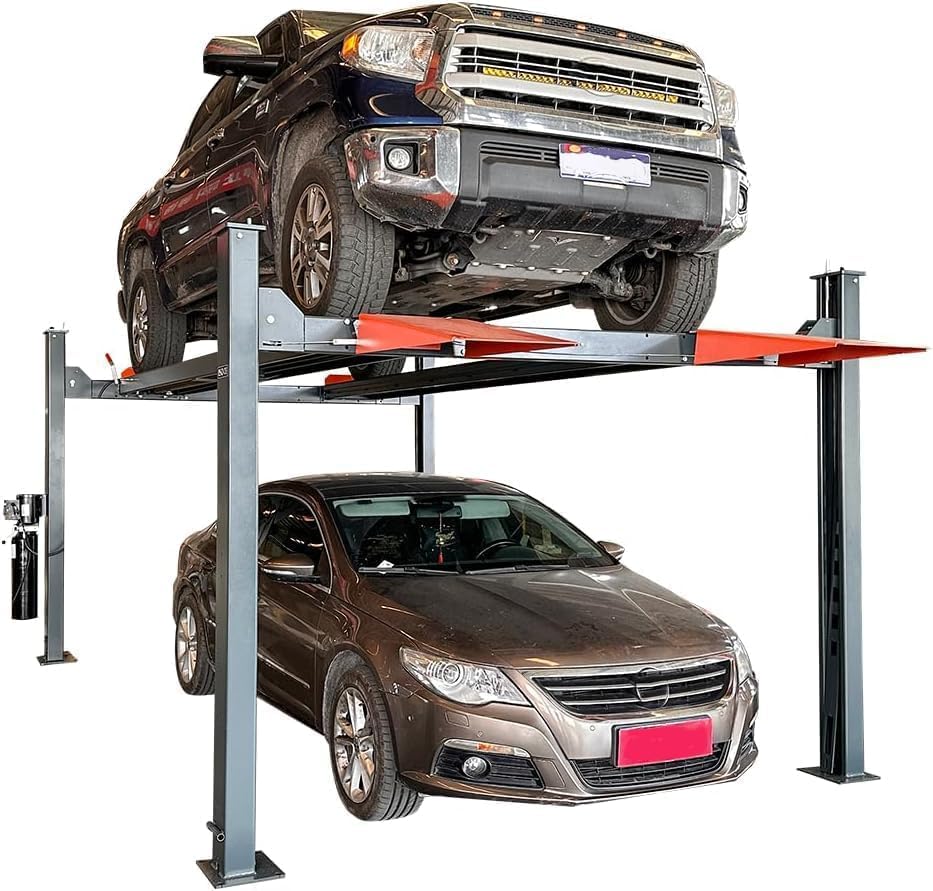
A 4 post car lift is a piece of automotive equipment that uses four vertical pillars and two horizontal runways to raise a vehicle off the ground for maintenance or storage. You need a lift when you require a stable, elevated workspace that allows for under-chassis access, such as oil changes, exhaust repairs, or transmission work. To determine if a lift fits your space, you must measure your garage’s door height and the distance between your side walls to ensure the posts and runways do not obstruct entry or movement.
How a 4 post car lift provides a stable weight distribution platform
Standard automotive work on jack stands creates a risk of instability because the vehicle’s weight is concentrated on small points rather than a broad, level surface. A 4 post car lift solves this by distributing the vehicle’s weight across four structural pillars. This setup provides a level platform that remains stationary once the vehicle is raised, allowing a technician to move freely underneath the car without the fear of the vehicle shifting or sinking. By lifting the entire vehicle, it also allows for the removal of wheels and the inspection of the drivetrain in a controlled environment.
Owners of oversized vehicles should view our guide to the best 4 post car lift for wide vehicles.
How a 4 post car lift operates step by step
The operation of a 4 post car lift follows a specific mechanical sequence to move a vehicle from the ground to a working height.
For those building a private driveway, explore the best 4 post car lift for residential parking options.
- The user positions the vehicle over the runways, ensuring the tires are centered on the structural beams.
- The operator engages the power source, which directs fluid or electricity to the lifting mechanism.
- The lifting mechanism applies pressure to the cylinders, causing the four posts to rise simultaneously.
- The vehicle rises vertically as the runways move upward, maintaining a level plane.
- Once the desired height is reached, the system engages a mechanical lock to secure the position.
- The vehicle remains suspended on the runways until the lifting mechanism is reversed to lower the lift.
4 Post Car Lifts we have reviewed in detail
Prices across these 3 run from $3359 to $3899; each one has a full review here.
Compact garages require careful planning, so view our guide to the best 4 post car lift for limited space.


Parts and standards that affect 4 post car lift performance
Several engineering components and power standards determine how a 4 post car lift performs and what infrastructure you need to support it.
You can learn the technical jargon by viewing our guide to 4 post car lift terms and specs.
Rotary drive systems and safety locks
A Rotary Drive System ensures synchronized lifting of all four posts to prevent vehicle tilting. It works by using a synchronized gear or chain system that links the movement of every pillar, ensuring that if one side rises faster than the other, the vehicle does not lean. This is a critical feature for safety, as even a slight tilt can shift the center of gravity during a lift. A Safety Locking Mechanism provides a mechanical fail-safe to hold the vehicle during storage or service. These are usually steel pins or teeth that engage into holes in the post; they ensure that even if the power fails or a hydraulic line leaks, the lift cannot physically drop the vehicle.
Proper electrical setup is vital, so see how to choose a power supply for 4 post car lifts.
Hydraulic cylinders and runway beams
The Hydraulic Cylinder determines the lifting force and fluid pressure capacity of the system. This component converts fluid pressure into the linear motion required to push the posts upward. The size and rating of the cylinder dictate the maximum weight the lift can handle. The Runway Beam is the structural surface that supports the vehicle’s weight during lifting. These beams must be thick enough to resist bending under the weight of a heavy truck or SUV. If the beam gauge is too thin, the surface can experience structural deflection, where the metal bows or warps under load.
To ensure your motor is sufficient, view our guide to motor power for 4 post car lifts.
220V vs 110V and motor types
Choosing the correct power supply is a primary requirement for your workshop setup. 110V determines if the lift can run on a standard household outlet, which is common in residential garages but limits the speed and weight capacity of the motor. 220V determines if the lift requires industrial power infrastructure, which provides the higher voltage needed for heavy-duty lifting and faster cycle times. Furthermore, the choice of Hydraulic vs Electric dictates the lifting mechanism, speed, and maintenance requirements for the motor. Hydraulic systems use fluid pressure to move the cylinders, while electric systems use a motor and chain or screw drive to move the posts.
Safety depends on capacity, so check our guide to weight capacity for 4 post car lifts.
How a 4 post car lift changes your workspace
Owning a 4 post car lift changes how you manage vehicle maintenance by providing a dedicated, elevated work zone. In a professional shop, this means a technician can work on two cars simultaneously—one on the lift and one on a floor jack—increasing the number of jobs completed per hour. In a home garage, it allows you to perform complex repairs, such as suspension swaps, that are impossible to do safely with a standard floor jack. Because the vehicle is elevated on runways, you can also use the space underneath for storage or to move tools freely without tripping over the car’s undercarriage.
Different designs serve different needs, so view our breakdown of the types of 4 post car lifts.
When a 4 post car lift outperforms a hydraulic jack for heavy repairs
The difference shows up most clearly when performing heavy repairs where the vehicle must remain static for long periods. A 4 post car lift provides a stable platform that does not “creep” or settle over time like a hydraulic jack might. However, the difference does not show up in tasks that only require wheel removal or minor oil changes. If you only ever work on tires, the added cost and footprint of a 4 post car lift may not be necessary, as a simple jack and stands provide the same result for those specific tasks.
Detailed performance data is available in our spec breakdown of the MutsMover 4-Post Lift.
Who needs a 4 post car lift and who does not?
You need a 4 post car lift if you perform frequent under-chassis repairs or need to store a vehicle in a way that keeps it off the ground. This is the standard choice for professional repair shops and home mechanics who perform heavy mechanical work like transmission replacements or full suspension overhauls. If you have a high volume of work or need to maximize your floor space by “stacking” vehicles, a lift is a requirement for your operation.
Specific technical data is available in our spec breakdown of the KT-4H950 4 Post Lift.
Why a floor jack and stands are better for basic maintenance
You do not need a 4 post car lift if your automotive needs are limited to basic maintenance like oil changes, brake pad swaps, or tire rotations. For these tasks, a high-quality floor jack and a set of heavy-duty jack stands are more cost-effective and occupy less space. Additionally, if your garage lacks the ceiling height or the electrical infrastructure to support a lift, a 4 post car lift is not a viable option for your location.
Detailed measurements are provided in our spec breakdown of the BendPak HD-7W.
The other 4 post car lift guides we have published
- The 4 Post Car Lifts That Work Best for Tall Vehicles Under $4000
- Which 4 Post Car Lift Is Best for Wide Vehicles?
- Best 4 Post Car Lifts for Residential Parking
- Heavy Duty 4 Post Car Lifts for Trucks Under $4000 Compared
- Choosing the Best 4 Post Car Lift for Limited Space
- The 4 Post Car Lifts That Work Best for Beginners